Customer Onboarding, Adoption Strategy, and Implementation Plan for Generative AI
Overview
Successful generative AI implementation requires a systematic methodology that evaluates organizational readiness, aligns AWS capabilities with business objectives, and establishes a structured adoption pathway. This document outlines our comprehensive approach to customer onboarding and adoption strategy for sustainable generative AI implementation on AWS.
Generative AI Readiness Assessment Framework
The assessment framework provides a comprehensive evaluation of organizational readiness across technical, data, and human capital dimensions. This structured approach ensures that generative AI initiatives are built on solid foundations and aligned with business objectives.
Organizational Maturity Evaluation
AWS Infrastructure Assessment
Organizations leveraging AWS for generative AI benefit significantly from managed services that eliminate infrastructure complexity while providing enterprise-grade security and scalability. The assessment evaluates existing AWS adoption maturity by examining current usage of compute services like Amazon EC2, AWS Lambda, and container services (ECS/EKS), alongside experience with AI/ML services including Amazon Bedrock, Amazon Q, and Amazon SageMaker.
The evaluation also considers data services implementation across Amazon S3, Amazon RDS, Amazon Redshift, and data lake architectures, while assessing security posture through AWS IAM configurations, VPC setup, and compliance frameworks. Operational maturity is measured through CloudFormation/CDK usage, monitoring with CloudWatch, and established CI/CD pipelines.
Organizations with mature AWS DevOps practices consistently demonstrate higher readiness for generative AI adoption, as they possess the operational discipline and cloud-native mindset required for managing complex AI systems at scale.
Data Infrastructure and Quality Assessment
Data readiness forms the foundation of successful generative AI implementations. The assessment evaluates data storage architectures including Amazon S3 data lakes and database implementations across RDS, DynamoDB, and Redshift. Data quality analysis focuses on completeness, accuracy, and consistency of existing datasets, while data governance evaluation examines AWS Lake Formation implementations, IAM policies, and data lineage tracking capabilities.
Compliance assessment ensures alignment with regulatory requirements such as GDPR, HIPAA, or industry-specific regulations through AWS compliance frameworks and security controls. This comprehensive data evaluation provides the foundation for determining which generative AI use cases are technically feasible and which data preparation efforts will be required.
Skills and Competency Analysis
The skills assessment identifies existing organizational capabilities and critical gaps across multiple domains. Current team familiarity with AWS AI/ML services provides the baseline for technical readiness, while data science skills including machine learning, prompt engineering, and model evaluation capabilities determine the organization's ability to implement and optimize generative AI solutions.
Development skills assessment covers API integration, serverless development, and cloud-native architectures, ensuring teams can effectively integrate generative AI capabilities into existing systems. Understanding of responsible AI practices and bias mitigation demonstrates organizational readiness for ethical AI deployment.
Organizations with strong learning cultures and established AWS cloud experience consistently demonstrate higher generative AI adoption success rates, as they possess both the technical foundation and cultural adaptability required for AI transformation.
Business Context and Use Case Identification
Industry-Specific Considerations
Industry context significantly influences generative AI implementation strategies and priorities. Financial services organizations require strict regulatory compliance with SOX and PCI-DSS standards, emphasizing risk management and customer privacy protection. Healthcare organizations must navigate HIPAA compliance requirements while ensuring patient data protection and seamless clinical workflow integration.
Manufacturing organizations typically focus on operational efficiency improvements, quality control automation, and supply chain optimization opportunities. Retail organizations prioritize customer experience enhancement, inventory management automation, and personalization capabilities that drive revenue growth and customer satisfaction.
Use Case Discovery and Prioritization
The systematic identification process begins with comprehensive stakeholder interviews across business units to identify pain points and automation opportunities. Current workflow evaluation reveals processes suitable for augmentation or complete automation through generative AI capabilities.
The prioritization matrix evaluates potential use cases based on business impact potential, technical feasibility within existing AWS infrastructure, data availability and quality, and regulatory constraints. This structured approach ensures that initial implementations focus on high-value, low-risk opportunities that demonstrate clear business value.
Common high-value use cases consistently include document processing and analysis, customer service automation through intelligent chatbots, content generation for marketing and communications, and data analysis acceleration for business intelligence applications.
Risk Tolerance and Budget Assessment
Organizational risk appetite determines the appropriate implementation approach, balancing experimental projects with proven solutions. Investment capacity assessment encompasses technology costs, personnel requirements, training investments, and ongoing operational expenses. AWS cost optimization strategies leverage managed services and flexible pricing models to minimize infrastructure investment while maximizing capability access.
Strategic Planning and Roadmap Development

Adoption Strategy Formulation
Phased Implementation Approach
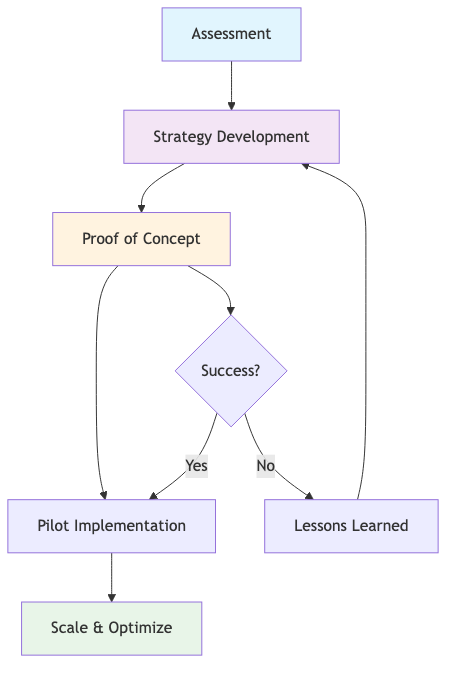
The implementation strategy follows a structured five-phase approach designed to minimize risk while maximizing learning and business value. The initial Assessment & Planning phase spans the first two months, focusing on comprehensive readiness evaluation and detailed strategy development based on organizational capabilities and constraints.
The Proof of Concept phase during months three and four involves small-scale pilots using Amazon Bedrock for foundation model access, Amazon Q for enterprise AI assistance, or SageMaker for custom model development. These time-boxed experiments validate technical feasibility and business value with minimal organizational disruption.
Pilot Implementation extends from month five through eight, developing production-ready solutions with limited scope that demonstrate scalability and operational viability. The Scale & Optimize phase during months nine through twelve expands successful use cases across the organization while implementing performance optimization and cost management strategies.
Continuous Innovation represents an ongoing commitment to bottom-up innovation and advanced capability development, ensuring the organization remains at the forefront of generative AI advancement.
Organizational Structure Updates
Successful generative AI adoption requires strategic organizational changes to support cross-functional collaboration and rapid innovation. The AI Center of Excellence serves as a cross-functional team providing governance frameworks and best practices across all generative AI initiatives. The Cloud Competency Center functions as the AWS expertise hub, offering technical guidance and ensuring optimal use of AWS services and capabilities.
Change management initiatives include comprehensive training programs and strategic communication strategies that prepare the organization for AI-driven transformation while maintaining operational continuity.
Roadmap Definition and Feature Backlog
Project Prioritization Matrix
The prioritization framework evaluates projects across four critical dimensions to ensure optimal resource allocation and maximum business impact. Business impact assessment considers revenue potential, cost savings opportunities, and operational efficiency gains that align with strategic objectives. Technical feasibility evaluation examines AWS service availability, data readiness levels, and implementation complexity within existing infrastructure constraints.
Resource requirements analysis encompasses team capacity, budget allocation, and realistic timeline expectations, while risk level assessment addresses regulatory constraints, technical challenges, and organizational change management requirements. This comprehensive evaluation ensures that selected projects balance ambition with achievability.
Feature Backlog Management
The living backlog maintains a dynamic portfolio of opportunities across three strategic categories. Quick wins focus on immediate value delivery through document processing automation, email response systems, and basic chatbot implementations that demonstrate rapid ROI and build organizational confidence.
Strategic initiatives encompass advanced analytics platforms, personalization engines, and comprehensive process automation that drive long-term competitive advantage. Innovation projects explore emerging use cases and experimental applications that position the organization at the forefront of generative AI advancement.
Implementation Methodology
Rapid Experimentation Framework
Proof-of-Concept Development
The experimentation framework emphasizes time-boxed experiments spanning two to four weeks using AWS managed services to minimize infrastructure overhead and accelerate learning. Amazon Bedrock provides access to foundation models from Anthropic Claude, AI21 Labs, Cohere, and Amazon Titan, enabling rapid model evaluation and comparison.
Amazon Q Business serves as an enterprise AI assistant for document analysis and business intelligence applications, while Amazon Q Developer offers code generation, debugging, and development assistance capabilities. SageMaker JumpStart facilitates both pre-trained foundation model deployment and custom model development for specialized requirements.
Each experiment includes clearly defined success criteria, specific metrics, realistic timelines, and concrete deliverables. Risk mitigation strategies employ sandboxed environments and carefully limited scope to prevent unintended consequences while maximizing learning opportunities.
Iterative Development Process
The development methodology employs sprint-based cycles lasting two weeks with regular stakeholder feedback integration to ensure alignment with business objectives and user requirements. AWS DevOps integration leverages CodePipeline for continuous integration, CloudFormation for infrastructure as code, and automated testing frameworks to maintain quality and reliability.
Performance monitoring utilizes CloudWatch metrics and custom dashboards to provide real-time visibility into system performance and user engagement. Continuous optimization focuses on model performance tuning and cost optimization strategies that maximize value while minimizing operational expenses.
Enablement and Capability Building
Training Programs
Comprehensive enablement programs address diverse organizational roles through targeted training paths. Executive programs focus on AI strategy development and business impact assessment, ensuring leadership understands both opportunities and responsibilities associated with generative AI adoption. Developer training emphasizes AWS AI services integration, API development, and serverless architecture patterns that enable rapid application development and deployment.
Data scientist programs cover SageMaker capabilities, model fine-tuning techniques, and advanced prompt engineering strategies that optimize model performance for specific use cases. Operations teams receive specialized training in MLOps practices, monitoring strategies, and cost management techniques that ensure sustainable and efficient AI operations.
Knowledge Transfer and Innovation Culture
Knowledge transfer processes establish documentation standards for technical guides, operational runbooks, and best practices that support consistent implementation across the organization. Communities of practice facilitate regular knowledge sharing and collaboration, fostering cross-functional learning and innovation.
Case study development captures success stories and lessons learned, creating organizational knowledge assets that accelerate future implementations. Innovation programs include quarterly hackathons focused on generative AI applications, dedicated innovation time for exploratory projects, and self-service platforms that provide AWS service access within appropriate governance guardrails.
Recognition programs celebrate successful innovations while encouraging learning from failures, creating a culture that supports experimentation and continuous improvement.
Success Measurement and Continuous Improvement
Metrics and Evaluation Framework
Success measurement encompasses comprehensive business impact metrics including productivity improvements through time savings and process automation efficiency, cost optimization through AWS resource utilization and operational cost reductions, revenue impact from new capabilities and improved customer experiences, and quality improvements through error reduction and consistency gains.
Technical performance monitoring tracks model performance metrics including accuracy, response times, and throughput, alongside AWS cost management through service usage optimization and reserved capacity planning. System reliability metrics monitor uptime, error rates, and scalability performance, while security compliance ensures proper access controls, data protection, and audit trail maintenance.
Outcome Evaluation and Methodology Evolution
Post-implementation reviews conduct comprehensive project retrospectives that capture technical insights, process improvements, and stakeholder feedback. Knowledge documentation preserves best practices, common pitfalls, and proven solution patterns for future reference and application.
Regular outcome evaluation assesses use case effectiveness through success rate analysis, organizational readiness through maturity progression tracking, and strategic alignment through business objective achievement and ROI realization measurement. This systematic evaluation process ensures continuous methodology refinement based on accumulated experience and evolving AWS service capabilities.
Conclusion
This methodology provides a comprehensive framework for generative AI adoption on AWS, emphasizing systematic readiness assessment, strategic planning, and iterative implementation. By leveraging AWS managed services and focusing on organizational capability development, businesses achieve sustainable value from generative AI investments while effectively managing risk and building long-term competitive advantages in an AI-driven marketplace.